



Who is Chartered Engineer?
A Chartered Engineer in India is a professionally recognized engineer certified by the Institution of Engineers (India). They are qualified to provide technical assessment, valuation, certification, and inspection reports for machinery, equipment, plant, and engineering assets.
Chartered Engineers are widely required for import export, customs, insurance, and financial documentation purposes.
Kanti Chandra Bhattacharya is one of the leading Govt Approved Valuers. We are associates of Government –Registered Valuers, Architects, Mechanical and Automobile Engineer. We have to our credit valuation work of commercial/residential/industrial premises for banks & limited companies. We provide Valuation/revaluation of assets, properties, land and plant & machineries all under one roof.
A professional property valuation and management is approved by and Registered with the income Tax Department and institution of Valuers, Chartered Engineers, Appraisers, Corporate Valuers, Government Approved Valuers.
Note:– All questions to be answered by the valuer. If any particular question does not apply to the property under valuation, he may indicate so. If the space provided is not sufficient details may be attached on separate sheets.
Part – I
| 1 | 2 |
General:
1. Purpose for which valuation is made.
2. Date as on which valuation is made.
3. Name of the owner/owners.
4. If the property is under joint ownership/co-ownership, share of each such owner. Are the shares undivided.
5. Brief description of the property.
6. Location, Street, Ward No.
7. Survey/Plot No. of land.
8. Is the property situated in residential/commercial, mixed area/industrial area.
9. Classification of locality – high class/middle class/poor class.
10. Proximity to civic amenities, like schools, hospitals, offices, market, cinemas, etc.
11. Means and proximity to surface communication by which the locality is served.
Land:
12. Area of land supported by documentary proof: Shape, dimensions and physical features.
13. Roads, street or lanes on which the land is abutting;
14. Is it free-hold or lease-hold land ?
15. If lease-hold, the name of leaser/lessee, nature of lease, date of commencement and terms of renewal of
lease:
(i) Initial premium;
(ii) Ground rent payable per annum;
(iii) Unearned increase payable to the leaser in the event of sale or transfer.
(ii) Ground rent payable per annum;
(iii) Unearned increase payable to the leaser in the event of sale or transfer.
16. Is there any restrictive covenant in regard to use of land? If so, attach a copy of the covenant.
17. Are there any agreements of easements? If so, attach copies.
18. Does the land fall in an area included in any Town Planning Plan of Government or any statutory body? If so, give particulars.
19. Has any contribution been made towards development or is any demand for such contribution still outstanding?
20. Has the whole or part of the land been notified for acquisition by Government or statutory body? Give date of notification.
21. Attach a dimensioned site plan.
Improvements:
22. Attach plans and elevation of all structures standing on the land and a lay-out plan.
23. Furnish technical details or the building on a separate sheet. The annexure to this Form may be used.
24. (i) Is the building owner-occupied/tenanted/both?
(ii) If partly owner-occupied, specify portion and extent of area under owner-occupation.
25. What is the Floor Space Index Permissible and percentage actually utilised?
23. Furnish technical details or the building on a separate sheet. The annexure to this Form may be used.
24. (i) Is the building owner-occupied/tenanted/both?
(ii) If partly owner-occupied, specify portion and extent of area under owner-occupation.
25. What is the Floor Space Index Permissible and percentage actually utilised?
Rents:
26. (i) Names of tenants/lessees/licensees, etc.
(ii) Portions in their occupation.
(iii) Monthly or annual rent/compensation/license fee, etc. paid by each.
(iv) Gross amount received for the whole property.
27. Are any of the occupants related to, or close business associates of the owner?
28. Is separate amount being recovered for the use of fixtures, like fans, geysers, refrigerator, cooking ranges, built-in wardrobes, etc. or for service charges? If so, give details.
29. Give details of water and electricity charges, if any, to be borne by the owner.
30. Has the tenant to bear the whole or part of the cost of repairs and maintenance? Give particulars.
31. If a lift is installed, who is to bear the maintenance and operation – owner or tenant?
32. If a pump is installed, who has to bear the cost of maintenance and operation – owner or tenant?
33. Who has to bear cost of electricity charges for lighting of common space like entrance hall, stairs, passages, compound etc. – owner or tenant ?
34. What is the amount of property tax? Who is to bear it? Give details with documentary proof.
35. Is the building insured? If so give the policy no., amount for which it is insured and the annual premium.
36. Is any dispute between landlord and tenant regarding rent pending in a court of law?
37. Has any standard rent been fixed for the premises under any law relating to the control of rent?
Sales:
38. Give instances of sales of immovable property in the locality on a separate sheet, indicating the name and address of the property, registration no., sale price and area of land sold.
39. Land rate adopted in this valuation.
40. If sale instances are not available or not relied upon the basis of arriving at the land rate.
Cost of Construction:
41. Year of commencement of construction and year of completion.
42. What was the method of construction – by contract, by employing labour directly/both ?
43. For items of work done on contract, produce copies of agreements.
44. For items of work done by engaging labour directly, give basic rates of material and labour supported by documentary proof.
Part – II : Valuation
Here the registered valuer should discuss in detail his approach to valuation of the property and indicate how the value has been arrived at supported by necessary calculations.
Part – III : Declaration
I hereby declare that –
(a) The information furnished in Part I is true and correct to the best of my knowledge and belief;
(b) I have no direct or indirect interest in the property valued;
(c) I have personally inspected the property on…………………….;
(d) I have not been convicted of any offence and sentenced to a term of imprisonment.
or I have been convicted of an offence and sentenced to a term of imprisonment for a period of …………………………………………………………[particulars of offence and sentence attached]; and (e) I have not been found guilty of misconduct in my professional capacity.
or I have been found guilty of misconduct in my professional capacity (particulars attached).
(b) I have no direct or indirect interest in the property valued;
(c) I have personally inspected the property on…………………….;
(d) I have not been convicted of any offence and sentenced to a term of imprisonment.
or I have been convicted of an offence and sentenced to a term of imprisonment for a period of …………………………………………………………[particulars of offence and sentence attached]; and (e) I have not been found guilty of misconduct in my professional capacity.
or I have been found guilty of misconduct in my professional capacity (particulars attached).
Date……
| Place….. | Signature of Valuer |
ANNEXURE TO FORM O-1
| Technical Details | Main Building | Annexe | Servants Quarters | Garages | Pump House |
| 1 | 2 | 3 | 4 | 5 | 6 |
1. No. of floors and height of each floor.
2. Plinth area floor-wise (As per IS : 3861-1966).
3. Year of construction.
4. Estimated future life.
5. Types of construction—load bearing walls/R.C.C. frame/steel frame.
6. Type of foundations.
7. Walls :
(a) Basement and plinth.
(b) Ground floor.
(c) Superstructure above ground floor.
8. Partitions
9. Doors and windows (Floorwise) :
(a) Ground floor.
(b) 1st floor.
(c) 2nd floor. etc.
10. Flooring (Floorwise) :
a) Ground floor.
b) 1st floor.
c) 2nd floor, etc.
11. Finishing (Floorwise)
(a) Ground floor.
(b) 1st floor.
(c) 2nd floor etc.
12. Roofing and terracing.
13. Special architectural or decorative features, if any.
14.
(i) Internal wiring—surface or conduit
(ii) Class of fittings superior/ordinary/poor.
15. Sanitary installations:
(a)
(i) No. of water closets.
(ii) No. of lavatory basins.
(iii) No. of urinals.
(iv) No. of sinks.
(v) No. of bath tubs.
(vi) No. of bidets.
(vii) No. of geysers.
(b) Class of fittings–superior coloured/superior white/ordinary.
16. Compound wall :
(i) Height and length
(ii) Type of construction.
17. No. of lifts and capacity.
18. Underground pump–capacity and type of construction.
19. Overhead tank :
(i) Where located.
(ii) Capacity.
(iii) Type of construction.
20. Pumps–No. and their horse power.
21. Roads and pavings within the compound, approximate area and type of paving.
22. Sewage disposal–whether connected to public sewers. If septic tanks provided, no. and capacity.
Signature of Valuer
Note :Necessary modification in this Annexure may be made to suit the property under valuation.
Role and Importance of a Chartered Engineer in Valuation
A Chartered Engineer (CE) is a professionally recognized engineer who has been certified by the Institution of Engineers (India) – IEI after meeting the required academic qualifications, technical expertise, and industry experience.
This prestigious title allows an engineer to officially authenticate, assess, and certify technical documents, machinery, plant, equipment, and various engineering assets.
Chartered Engineers are widely required for import export, customs, insurance, and financial documentation purposes, including Property Valuation Services in India.
They also assist in valuation for taxation purposes such as capital gains, where accurate reporting and compliance are essential.
A Chartered Engineer plays an important role in valuation, inspection, and certification work across multiple sectors. Their reports are widely accepted by government departments, customs authorities, banks, insurance companies, industries, and international organizations.
A Chartered Engineer in India plays a key role in technical valuation, certification, and inspection services across various industries.
Key Responsibilities of a Chartered Engineer
Certification of machinery and equipment
Valuation for import/export, customs, and duty drawback
Technical inspection and condition assessment
Preparing estimation reports for industrial assets
Providing project feasibility and engineering opinions
Supporting banks, industries, corporates, and individuals with technical documents
Our Chartered Engineer in India services include machinery valuation, technical inspection, and certification for industrial and financial purposes.

Get in Touch!
Enquiry Now
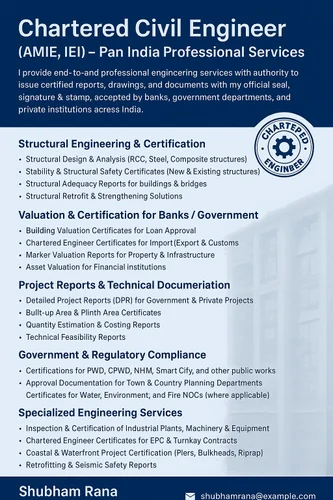

Why Chartered Engineers Add Value to Valuation Services
Chartered Engineers bring verified technical credibility to valuation assignments. Their certification ensures:
Accurate technical assessment
Legally valid valuation reports
Approval and acceptance by government authorities
Proper documentation for audits, finance, taxation, and visa purposes
At Valuers Online, we work with experienced and government-approved Chartered Engineers who provide professional valuation services for plant & machinery, industrial equipment, building structure assessments, insurance valuations, and technical certifications.
Chartered Engineer Services in India
Our Chartered Engineer services in India include machinery valuation, technical inspection, asset certification, plant and equipment assessment, insurance valuation support, building structure assessment, project feasibility opinions, and reports for import export, customs, and duty drawback purposes.
Plant and Machinery Valuation by Chartered Engineer
A Chartered Engineer for machinery valuation helps determine the condition, age, utility, replacement value, and fair technical worth of plant, equipment, and industrial assets. These reports are useful for sale, purchase, finance, insurance, import export, and internal documentation purposes.
Chartered Engineer Certification for Import Export
Chartered Engineer certification is often required for import export documentation, customs assessment, used machinery valuation, and technical verification of equipment. Such reports help support compliance, documentation, and acceptance before relevant authorities.
Frequently Asked Questions
Q1. What is a Chartered Engineer in India?
A Chartered Engineer in India is a professionally recognized engineer certified by the Institution of Engineers (India) who can provide technical assessment, inspection, and certification reports.
Q2. When is a Chartered Engineer required for valuation?
A Chartered Engineer may be required for machinery valuation, plant and equipment assessment, import export documentation, insurance support, and technical certification.
Q3. Are Chartered Engineer reports accepted by authorities?
Yes, Chartered Engineer reports are widely used for technical documentation, valuation, customs related work, finance, insurance, and industrial purposes depending on the requirement.
Q4. What documents may be needed for Chartered Engineer certification?
The required documents may include invoice, photographs, machine details, technical specifications, ownership records, and purpose of valuation or certification.
Q5. Do Chartered Engineers help in plant and machinery valuation?
Yes, Chartered Engineers help in plant and machinery valuation by assessing technical condition, utility, age, and valuation related factors.
Hiring a Chartered Engineer in India ensures accurate and reliable technical reports for valuation and compliance.
For professional Chartered Engineer services, feel free to Contact Us for expert assistance and quick support.